
When talking about the energy transition, there can be a tendency to focus on investment, technology, or policy and regulation. Yet the most important driving force behind the transition is people. From those designing and building the future energy system, to the customers using renewable power in new ways, to the communities hosting critical electricity generation or network infrastructure – people are central to ESB’s mission to deliver a clean, secure and affordable energy system.
As we work to bring our carbon emissions down to net zero by 2040, we need to do this in a way that is just, inclusive and trusted. This is why we place our commitment to people at the heart of all we do, as set out in our new strategic roadmap to 2030 ‘People-Centred Sustainability: Our Path to a People-Centred Energy Future’.
What is People-Centred Sustainability?
People‑centred sustainability describes how ESB delivers on its responsibility to people throughout the net zero transition. Reflecting our long‑standing commitment to supporting customers and communities through change, and building on just transition principles, it puts social outcomes at the heart of decision‑making – ensuring that environmental progress goes hand in hand with social responsibility.
As Eileen Hyland, People-Centred Sustainability Lead at ESB, explains: “People-centred sustainability is about turning intent into impact. It focuses on how our strategies, decisions, and day-to-day actions shape outcomes for people, including those who work for ESB, provide goods and services to us, rely on our services, and live in the communities that host and depend on our infrastructure.”
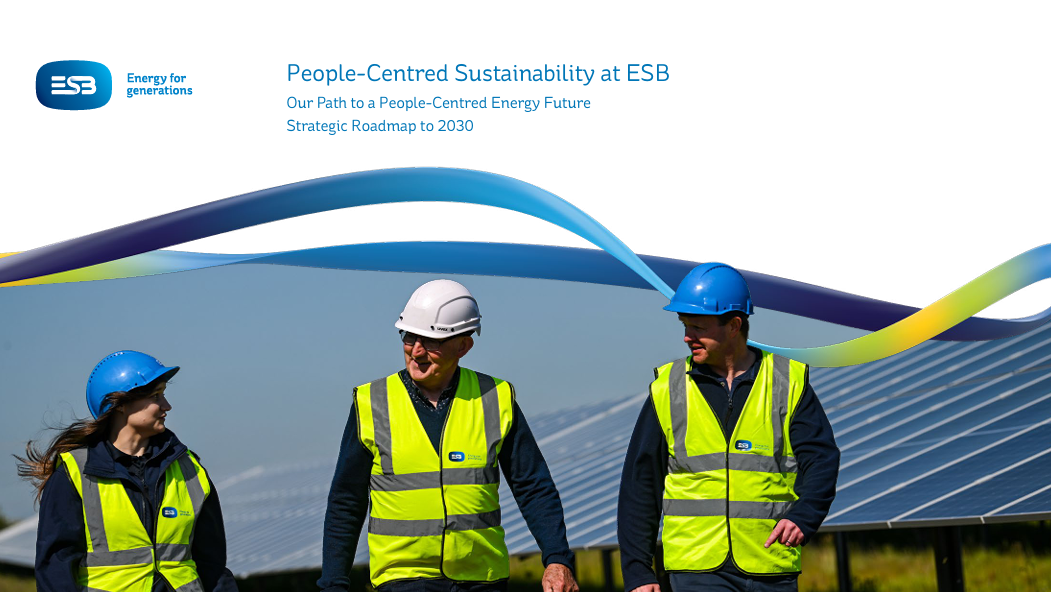
Our New Roadmap
Since ESB was established in 1927, people have always been at the core of what drives us. We already embed people-centred sustainability across our operations through a strong foundation of established strategies, policies, and frameworks that define how we engage, act, and deliver value for the people and communities we serve.
Now, our new strategic roadmap builds on this foundation by acting as an integrating framework – bringing together these existing elements into a coherent and consistent approach focused on delivering positive outcomes for people. It centres around four key social groups:
Communities: Our aim is to partner with local communities to deliver and share the benefits of a clean energy future through early engagement, trust-building and tangible local value.
Employees: We aim to engage with employees to support a fair and inclusive transition, prioritising safety, capability development, meaningful work and growth in a workplace that values every voice.
Customers: We will empower customers to be part of the energy transition and to benefit from reliable, affordable and clean energy.
Value chain workers: We will engage with suppliers to build strong and responsible supply chains that protect workers’ rights, improve livelihoods, and support a resilient and sustainable energy transition.
Aligned with ESB’s Sustainability Leadership Plan and Net Zero by 2040 Strategy, the roadmap ensures that people-centred sustainability is embedded across our business.
Measuring our Progress
The new roadmap does not replace or duplicate ESB’s existing policies, strategies or charters. Rather, by providing a structured framework, it helps us to identify gaps, set clear ambitions across the four social groups, and translate those ambitions into practical actions supported by defined targets and measures. It also creates a shared understanding across ESB of how teams contribute to delivering people-centred outcomes.
For each of the objectives across our four social groups, we will track our progress through defined performance measures, targets, and transparent reporting.
| Social group | What we want to achieve | How we will measure success | Targets to 2030 |
| Communities & Society | Partner with local communities to deliver and share the benefits of a clean energy future through early engagement, trust-building, and tangible local value. | - € invested annually in Ireland’s energy infrastructure - % of new major capital programmes with Community Impact Assessments (CIAs) - Annual € invested through Community Benefit Funds - Annual € invested through the Energy for Generations Fund | - Deliver on ESB Networks Price Review 6 (PR6) Business Plan and on planned renewable generation investment by Generation & Trading in support of Net Zero by 2040 - 100% of new major capital programmes have a Community Impact Assessment - Community Benefit Fund investment increases year-on-year in line with planned renewable generation investment by Generation & Trading - €1m invested annually through the Energy for Generations Fund |
| Employees | Engage with employees to support a fair and inclusive transition, prioritising safety, capability development, meaningful work, and growth in a workplace that values every voice. | - Employee engagement score - Our Behaviours Our Voice Score (ESB's employee survey) - Female employees as % of workforce - Employees with disabilities as % of workforce - Universal Fair Pay Certification Achievement (Annual) - Enterprise Critical Future Capabilities Maturity Score | - >8.0 engagement score (ongoing) - Our Behaviours Our Voice Score >7.8 - 30% female employees - >6% employees with disabilities - Retain Universal Fair Pay Certification annually (FPI Fair Pay Innovation Lab Berlin) - Enterprise Critical Future Capabilities Maturity Score > 3.4 |
| Customers | Empower every customer to be part of the energy transition and to benefit from reliable, affordable, and clean energy. | - Number of smart meters installed - % Electric Ireland customers on smart tariffs - ESB will report annually on actions it takes to support an affordable, inclusive and competitive energy future. - Customer satisfaction score (%) | - 2.6m smart meters - 80% of Electric Ireland customers on smart tariffs - Annual reporting on actions to support an affordable, inclusive and competitive energy future - >85% satisfaction across customer-facing business lines |
| Value Chain Workforce | Engage with suppliers to build strong and responsible supply chains that protect workers’ rights, improve livelihoods, and support a resilient and sustainable energy transition. | - % suppliers covered by ESB’s Workers in the Value Chain Policy - Risk-based supplier compliance with ESB’s Workers in the Value Chain Policy - Participation in external collaborations focused on critical supply chains (to be defined based on spend and geographic risk e.g., gas, solar and batteries) | - ESB’s Workers in the Value Chain Policy applies to 100% of suppliers through ESB’s Requirements for Third Parties - Ongoing risk-based assurance process in place to assess supplier compliance with the Workers in the Value Chain Policy - Active participation in at least one external collaboration for each critical supply chain (e.g., gas, solar and batteries) |
Making a Difference for People
By embedding people-centred sustainability into decision-making and performance, we are strengthening our ability to deliver long-term social, environmental, and economic value – reinforcing our commitment to a net zero future that is not only low carbon, but also fair, inclusive, and trusted.
“ESB has always been committed to supporting people and communities through change,” concludes Hyland. “This roadmap helps us turn our ambitions into action and ensure that people remain central to our journey to net zero.”