
How can we meet rising energy demand while driving down carbon emissions? How can we reduce dependence on imported fossil fuels while keeping energy costs manageable for customers? These are some of the questions facing Ireland on the road to 2050, and how we choose to answer today will shape our energy system for generations.
The electricity sector will have a central role to play in making that future system clean, secure and affordable. The last few years have shown what’s possible when ambition meets action. Already, the volume of utility-scale renewable generation connected to Ireland’s electricity grid is higher than our peak demand. The system can now draw on over 2GW of solar power capacity and more than 750MW of battery electricity storage – two technologies that barely featured in our energy mix just five years ago. And this clean electricity is increasingly powering our daily lives, with over 195,000 electric vehicles now on Ireland’s roads and around 170,000 heat pumps in Irish homes and businesses.
New ESB report on Ireland's energy future
ESB’s new report ‘ For a Clean, Secure Energy Future: Ireland’s Pathway to a Net Zero Energy System by 2050’ looks at how we can build on this momentum. Underpinned by modelling from University College Cork, it sets out our vision for the Ireland of 2050: where homegrown renewable electricity powers most of our energy needs, backed up by low- or zero-carbon dispatchable energy, battery storage and interconnection. By accelerating electrification in sectors like transport, heating and industry, this clean energy can decarbonise our wider economy and society.
Taking a big-picture view of the energy system as a whole, the report explores what’s needed to make this reality. Key takeaways include:
Accelerating renewables
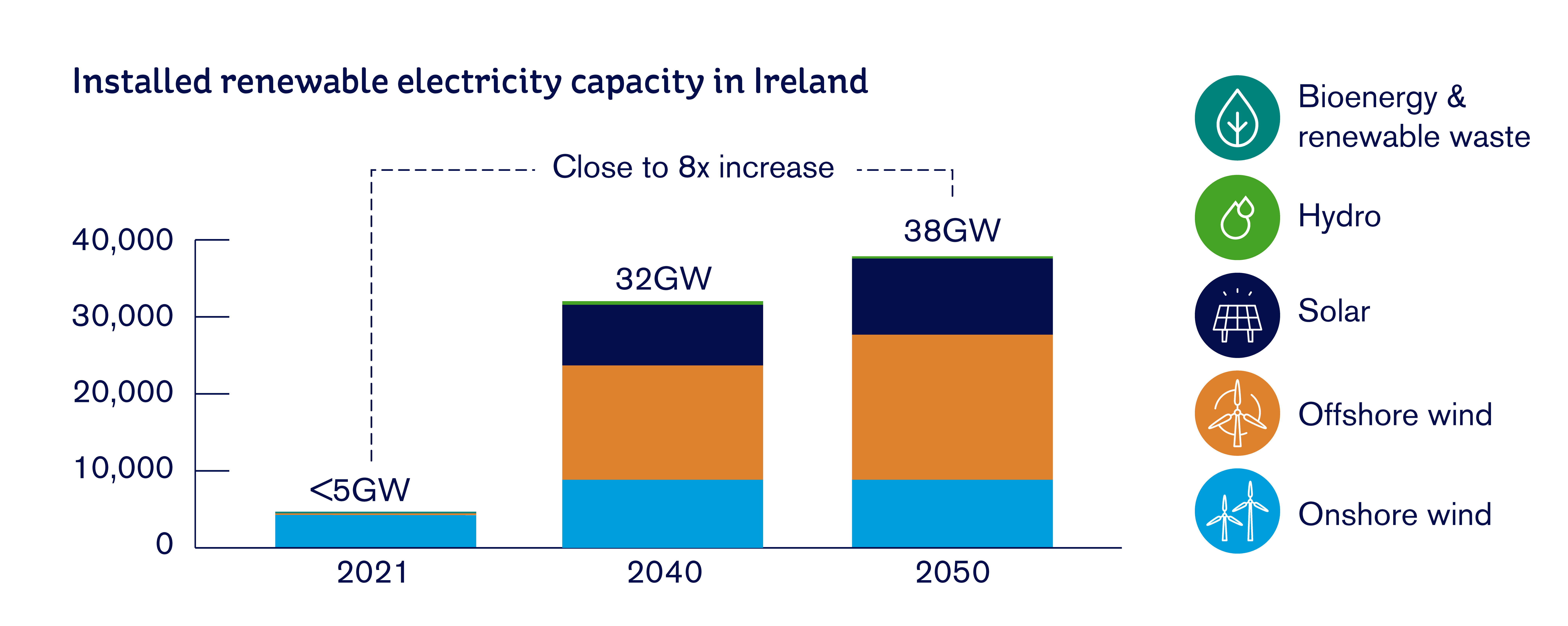
The modelling carried out for the report shows that by 2050, Ireland’s annual electricity needs will be 2.5 times greater than today. To meet that demand, a massive buildout of renewable power will be required – as much as eight times the volume we have today. Growth will be driven in the next few years by onshore wind and solar, with offshore wind playing a more significant role into the 2030s.
This future system must be able to run smoothly even on days of low wind and sunlight. The report explores options for back-up generation and storage most suited to Ireland’s requirements, with zero- or low-carbon dispatchable generation seen as particularly crucial for a secure net zero electricity system. An analysis of various scenarios – deploying green hydrogen as a zero-carbon fuel, or alternative options without hydrogen but using other mitigating technologies – shows that without hydrogen, a zero-carbon system resilient to prolonged periods of lo w wind and solar is unlikely to be possible.
Rethinking flexibility
As we move to a system powered by variable renewables, we will have to rethink how electricity flows through our network. Flexibility is the name of the game, both in terms of energy generation and how we consume power as individuals and communities.
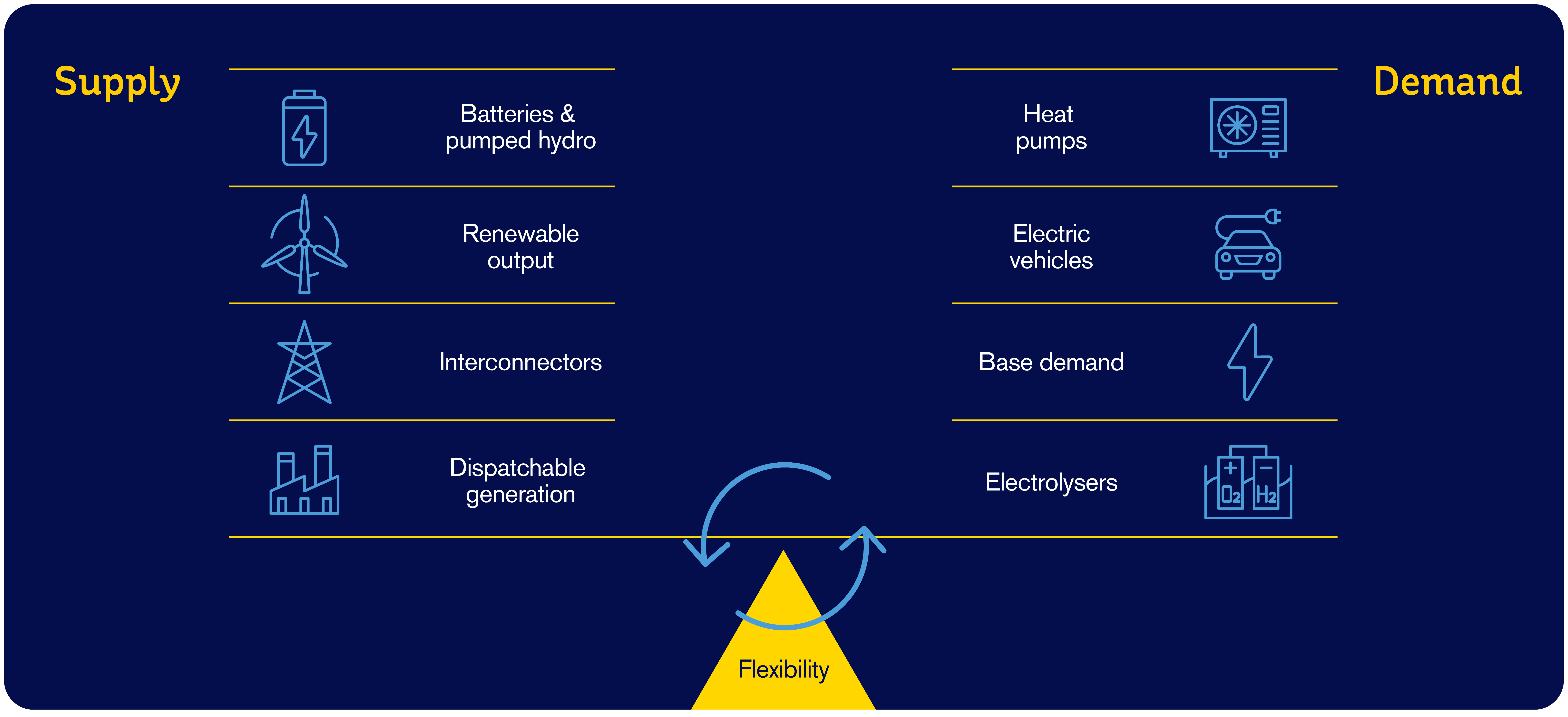
During times of low wind and solar, supply-side flexibility can kick in: the system can draw on electricity stored in large-scale battery systems, link in via interconnectors with the UK and European electricity networks, or fire up dispatchable peaking plants powered by low- or zero-carbon fuels.
On the demand side, smart technologies and shifts in consumer behaviour will mean using electricity differently to how we do today. For example, we can charge our electric vehicles at times of high wind, or adjust our home heat pump settings to maximise the use of renewable electricity. Excess wind or solar power can feed into batteries in our homes and cars, or at utility scale it can be diverted to short-term storage or to power pumped hydro generation.
Electrifying everything
To unlock the full potential of clean electricity, we need to accelerate electrification across the heating, transport and industry sectors. The report shows that by 2050, it will be possible to meet all residential and commercial energy and heating requirements with electricity. As for transportation, all but the heaviest and more niche vehicles can be electrified. Even in industry where very high-temperature processes make the picture more challenging, advances in heat-pump and electric boiler technologies will allow a sizeable percentage of demand to be met with electricity.
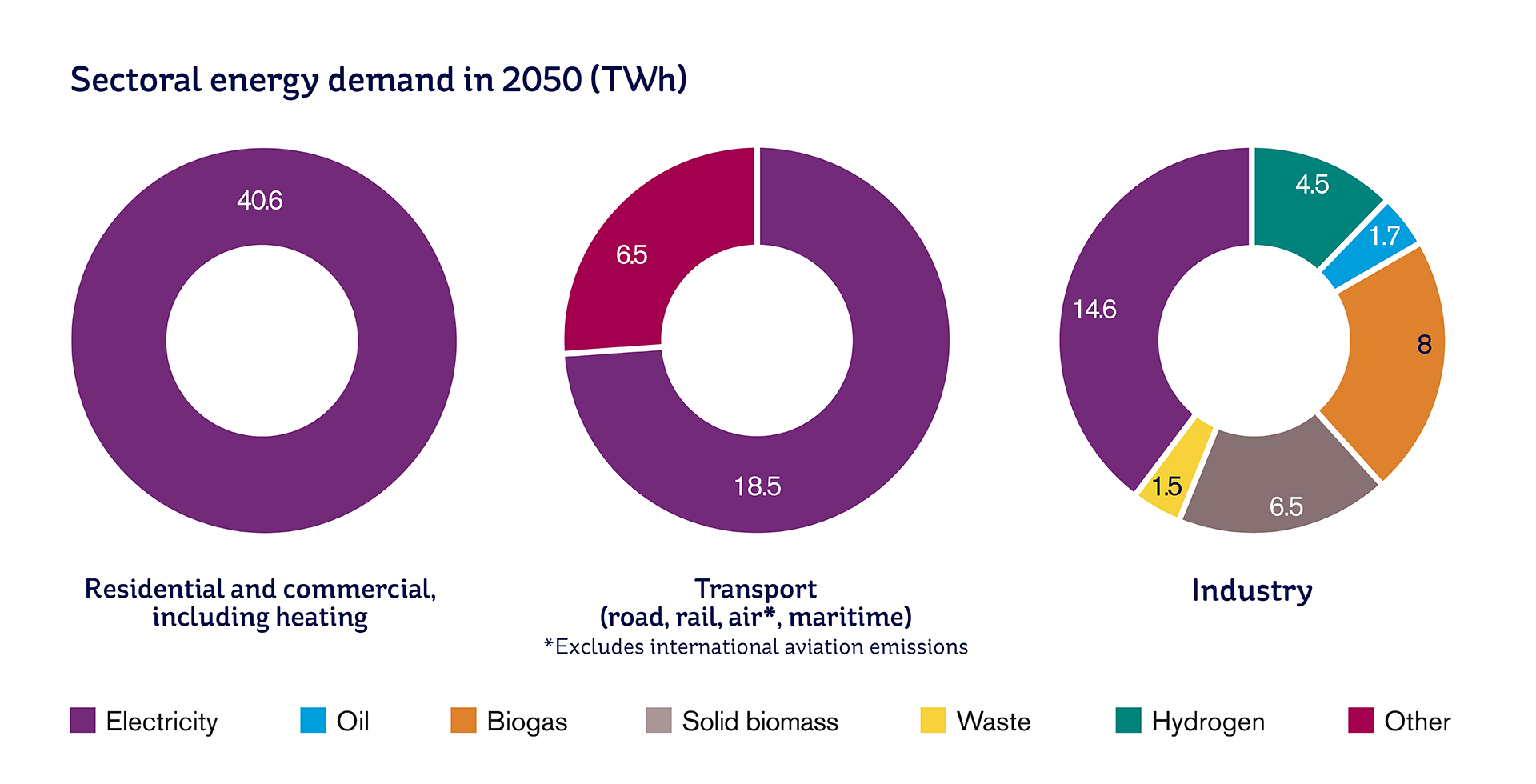
The use of electricity results in huge efficiency gains compared with oil and gas, as up to two-thirds of input energy from fossil fuels is lost as heat during generation. This means that even as population and demand for electricity rises, the overall energy required to meet the needs of transport and heating is expected decrease significantly between now and 2050.
Ensuring resilience and security of supply
By 2050 most people will be entirely reliant on electricity for their daily energy needs, making system resilience and security of supply absolutely vital. The coming years will see unprecedented investment in the electricity network through the Price Review 6 (PR6) programme, which will expand electricity network capacity, improve resilience, and support the connection of low carbon technologies.
There will be no one solution to the challenge of ensuring security of supply in the future energy system; rather a range or measures will be needed: from delivering a complementary mix of renewables along with significant dispatchable capacity, to enhancing supply- and demand-side flexibility, to providing for large-scale energy storage.
One clear message throughout the report is the need to take a whole-system approach to energy. Making this vision reality will require joined-up thinking and coordinated action on many fronts in parallel. At ESB, we are committed to working with partners and stakeholders across sectors to deliver the critical infrastructure needed and to empower customers and communities through the transition – so that together, we can make the most of this generational opportunity to shape a clean, secure and affordable energy future for Ireland.
Download Ireland's pathway to a net zero energy system by 2050 report.